Showing posts with label hummingbirds. Show all posts

Sunday, June 26, 2011

Have a Cigar - Mexican Cigar Plant


I usually have at least one blog entry per year singing the praises of this unique plant, the Mexican cigar plant or cuphea ignea.  Looking at the blooms, it should be obvious why it has this name.  The little blooms closely resemble small cigars or cigarettes.  If that's what the blooms are, then hummingbirds are notorious nicotine addicts, because they love the blooms on this plant.  


The blooms usually begin for me in early May and continue right up till the first frost of Autumn.  These plants thrive on heat and humidity, being native to Mexico and Central America.  The blooms are profuse for nearly the whole time.


The plant itself has a pleasing and full form if kept pinched back.  Occasionally through the year if mine starts to look lanky, I'll prune the tips back to encourage a more full look.  The leaves are a pleasing dark green that contrasts well with the bright orange flowers.  The shrub only gets to about 4' high for me and maybe 2.5' wide.


The plant dies to the ground in my zone 8b yard, but it has reliably come back for several years with no special protection.  It comes up from the roots once the ground warms up in the spring.  It prefers a sunny spot and semi-tropical conditions.  I wouldn't use it for a dry spot, though it does take minor droughts well.  As mentioned above, this is certainly one of the best hummingbird plants you can put in the ground, so it's truly worthy for that reason alone.  It's such a no-fuss workhorse that I really recommend it for the South.  It would probably be only an annual in zones any further north than zone 7b.

Saturday, June 25, 2011

Turk's Cap


It's quite easy to see why this plant is called Turk's Cap when you take a close look at the blooms.  They closely resemble old-fashioned turbans.  The most common color is this deep red one and it's the one I like most because of its attraction to hummingbirds. 


The plant has a pleasing shrub shape with large sycamore-like leaves.  The blooms are not overpowering on the plant, but there are plenty enough of them.  This plant is a close kin to the hibiscus clan and resembles them.  One difference from the hibiscuses is that Turk's Cap thrives in more shade.  This one is growing in the shade of a large Arizona Ash tree on the edge of my yard.  It is very healthy and happy.  These plants do not enjoy dry conditions and mine has an emitter from my irrigation system that supplies it with plenty of water.  They can survive in dryer conditions if forced to. 


Turk's Caps die to the ground after a freeze, but mine readily came back after last winter which was harsher than normal.  The Latin name for these is malvaviscus drummondii, in case anyone wants to look up more information on them.  The plants get to around 5' tall and nearly as wide.  They are wonderful for providing color to shady areas.  The blooms usually start in early June and will continue through the summer, into fall, and up to freeze time.  They are one of the absolute favorite plants of ruby-throated hummingbirds and are a must have for those wanting to attract these hummers.  Highly recommended for anyone in zones 7b and higher.  This is definitely an under-utilized plant in my area, which is a shame. 


Monday, May 16, 2011

The Larkspur Ascending


(For those who don't get it, the title is a reference to a beautiful classical piece by Ralph Vaughn Williams called "The Lark Ascending.")


Larkspurs are an annual related to Delphiniums (which unfortunately don't grow in the Deep South.)  They are planted from seed in October or November down here and will grow throughout the winter and bloom profusely from March through May.  The flowers are highly prized by bumblebees and hummingbirds.


My variety is called "Rocket" larkspurs and they get quite tall.  They are very reliable re-seeders and come back year after year without me having to replant.  I sometimes scatter the seeds in new places if I want them in other areas.


They come in all shades of blue, purple, pink, lavender, and white.  I really like the blue ones.  They are essential for the cottage garden look and for the insects and birds that I love so much.


They are best planted at the back of a bed because of their height.  I think they mix well with sweetpeas, dianthus, nigella, and petunias for a cool season bed.

Wednesday, October 27, 2010

Rioting Flowers


Several of my flower beds have run amok.  They are refusing to stay in bounds, re-seeding everywhere, clashing colors, and inviting every insect in the neighborhood to come over for nectar.  They are completely out of line and in open rebellion against any rules. 


Other than the Heavenly Blue morning glories, this bed is all volunteers.  The zinnias, cosmos, and sunflowers did not ask permission to party here.


These sunflowers are seeking to intrude into the yard and have even invited BIRDS over. 


The zinnias, meanwhile,  are openly flirting with every winged butterfly that passes by.  They will recklessly dance with ANY butterfly that chances by. 


All these intruding volunteers have passed on their attitude to the morning glories who have now flaunted their wares to every passing bumblebee. 


The place is in shambles!!


If that's not enough, another of my beds has started openly rebelling too.  This once orderly bed is now a shadow of it's former self.  The lantanas are sprawling everywhere in baudy profusion. 


Even the Double Knockout and the plumbago are waiste deep in lantanas.  Every traveling stranger of a hummingbird that passes through stops by for a nip of nectar at this nefarious-looking facility.  It's all too far gone for me to to anything about.  I'll just have to wait for a freeze to run this riff-raff off.

Friday, October 1, 2010

Mexican Bush Sage


Mexican Bush Sage (Salvia Leucantha) is a fall blooming salvia that grows into a nice shrub.  It starts off in spring like in the above picture.  The silvery foliage is nice even when not in bloom.  The purple flowers around it in the picture are verbenas.


Here is a picture of the full plant as it now looks at the end of September / beginning of October.  This is one of the best fall bloomers I have.  The butterflies and especially the migrating hummingbirds really appreciate the nectar this plant puts out.


Here is a close-up of the velvety blooms.   They are a nice purple and stick out the top of the plant, beckoning all flying friends to come in for a visit.


This plant is reliably perennial in my area of the country.  It likes a sunny location that has good drainage.  Like most salvias, it doesn't do well in boggy conditions.  However, this particular type does well in the humidity of the Southeast and is a good choice for our area.  A great plant to add to a non-irrigated bed because it takes drought like a champ.  It dies to the ground each winter only to come back strong in the spring.

Wednesday, September 8, 2010

Turkish Delight


The cute Turk's Cap is a member of the hibiscus family.  It does equally well in full sun or part shade.  The bright red, partially open blooms resemble a turban, hence the name.  It is a favorite nectar source for hummingbirds and so should be planted in any yard that wants to attract them. 


My bush is fairly new and small.  It's planted in filtered sun and gets plenty of water, which it likes.  This is a plant that does not take drought well.  It can get to almost small tree size in tropical climates, but dies back to the ground every winter in my zone 8b area.  It's hardy through zone 8, but should be protected in colder areas where the ground freezes.  At the end of summer when many of my plants are looking ragged, this lovely shrub is thriving and looking its best.

Friday, August 6, 2010

Cardinal Climber


Often mistaken for Ipomoea quamoclit ("Cypress Vine"), this closely-related plant is a cross between Ipomoea coccinea ("Red Morning Glory") and I. quamoclit ("Cypress Vine") with slightly coarser leaves.  The real Cardinal Climber has leaves that are more palmate than cypress vine and more ferny than morning glory.  It's quite confusing, especially since many seed companies label them wrongly.  The flowers are small, red, and tubular.  They are absolute hummingbird magnets.


This above picture may actually add to the confusion about identifying the cardinal climber because I have it growing with a real morning glory.  The large leaves you see are from the morning glory.  The cardinal climber blooms much earlier than the Heavenly Blue morning glories.  However, they play out and die before the MG's.  They are quite easy to grow from seed and will readily climb any structure you put them on.  The real Cardinal Climber is not invasive and the seeds have been sterile in my experience.  I have planted them every year for a number of years now and have yet to get even one volunteer plant the following year.  This is why I much prefer planting these to planting its parents - red morning glory and cypress vine.  Give this easy and well-behaved plant a chance and you won't regret it.  Just be sure you get the real thing or you will be stuck with an invasive, though beautiful, substitute.

Saturday, July 31, 2010

Native Honeysuckle


This is a native honeysuckle, or lonicera sempervirens.  I believe the variety name is Alabama Crimson, but since I threw away the label I'm not sure about that.  I have it growing on our mailbox and it continues to put on quite a show.  The reddish-orange flowers come out in profusion in April and then continue sporadically through the summer.  Hummingbirds dearly love this flower.  It does not have the fragrance of the rampant and invasive Japanese honeysuckle that you commonly see. 


Here is a picture of my vine at peak bloom in April.  Since this time it has completely taken over the mailbox and I have to trim it back so the poor postman can get to the box.  It remains full and lush in its growth with no disease at all.  It's really too bad that so few people down here grow this easy and beautiful vine.  It's native to our country and thrives nearly anywhere.  Mine is growing in full sun, but they grow equally well in partial shade.  They will grow in the cold of zone 4 and the heat of zone 9. 

Tuesday, July 27, 2010

Have a Cigar


This is a Mexican Cigar plant, or Cuphea ignea.  If this is a cigar, then consider all hummingbirds to be nicotine addicts, because they LOVE this small, flowering shrub.


The flowers are 1" - 2" tubes that are reddish-orange in color.  As you may know, red is also the favorite color of hummingbirds, so this makes the flowers doubly attractive to them. 


The shrub is fairly dense with dark green leaves.  The blooms usually start for me in May.  The plant dies back to the ground after a freeze, so it makes a fresh start each spring.  It's quite reliable to come back in my zone 8B yard.


The plant grows quickly and easily reaches 3' - 4' tall.  It makes a fine foundation plant or back-of-the-border perennial.  It does best in a sunny spot.  I have yet to see any disease or insect damage on my plant.


I recommend cutting this plant back about once a month after it reaches a height of 3 feet.  This keeps is bushier in appearance and less leggy at the bottom.  No gardener wishing to attract hummingbirds should be without this plant.  It grows quickly enough to use as an annual or potted plant in the North.

Thursday, July 8, 2010

Crocosmia Explosion


Crocosmias are hard for me to photograph.  Their airy habit and bright colors make them easy on the eyes but hard on the camera lens.  They are among the easiest of all the summer bulbs to grow in the Southeast and are extremely prolific.  Within two years of planting one specimen, you will have more than enough to share with your friends.


Here are some growing near my small herb bed.  They look nice alongside the achillea (yarrow,) bronze fennel, rue, parsley, and dill. 


Here's a close-up of the blooms.   I don't know what this variety is since it was given to me by a friend.  Nearly all cultivars grow the same and they come in all the fire-colored shades - yellow, orange, and red. 


Such bright colors don't mix with everything, but sure do brighten up where they are.  This is quite a versatile plant that will grow and bloom anywhere from bright sun to half-shade.  They don't do so well in boggy soil, but they tolerate drought superbly.  I have some growing in a dry un-irrigated bed and they are doing just as fine as the ones that get plenty of water.


The tube-shaped blooms are near the top of the food list for ruby-throated hummingbirds.  I've seen them busily buzzing around these blooms nearly every morning.  This is a perfect pass-along plant that will reward you over and over again with little effort.  What more can you ask for?

Wednesday, June 23, 2010

Victoria Blue Salvia

There are many types of salvias and they have an almost cultish following.  They come in so many variations and are so easy to care for that people just can't get enough of them.  They are also pretty deer resistant and many come back every year.  Those that don't come back are easy to grow from seed and some of them are ready re-seeders.  Add that this the fact that hummingbirds, butterflies, and bees love them and you have a recipe for a favorite flower. 


This blog entry is about my Victoria Blue salvia (Salvia farinacea).  This salvia is a perennial in my area of the country and makes these beautiful purple/blue spikes of flowers.  The plant is mounding and has a nice shape. 


I've got a clump of these planted in one of my butterfly beds.  They are growing in the midst of some pentas and tithonias.  I'm hoping they spread more and more and I can divide them to plant in other areas and share with friends.  There are many other types of salvias to grow besides these.  I have some salvia leucantha (Mexican bush sage) planted in another place in my yard and I have planted salvia coccinea in years past.  Nearly all do well throughout the US, as long as they get full or partial sun. 


Thursday, June 17, 2010

Do the Hummingbirds a Favor


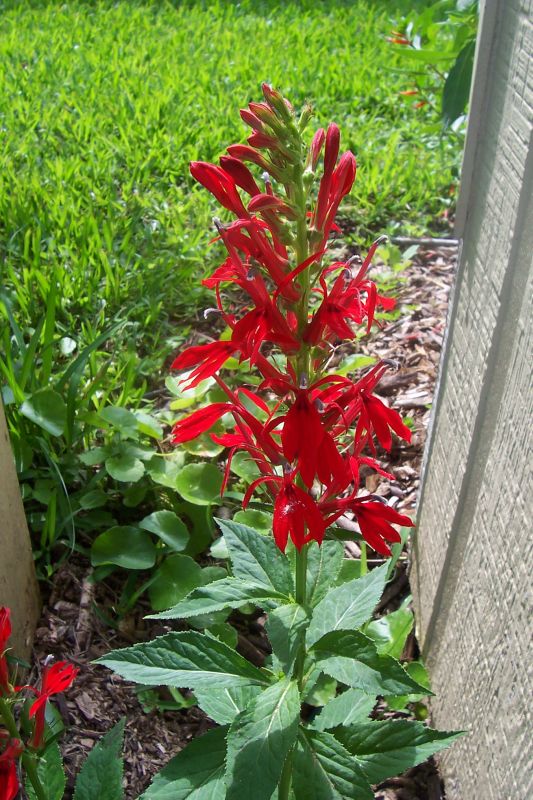
Do you like hummingbirds?  I do and it gives me great pleasure attracting them to my yard with flowers that they love.  You could not do better than to plant some cardinal flowers (lobelia cardinalis.)  This is one of the favorite foods of the ruby-throated hummingbird.  Not only that, but it is also one of the few flowers that blooms well in shade. 


Cardinal flowers are perennials that like a shady, moist spot.  They really grow well next to a shady pond.  In the late spring they send up tall spikes of the deepest red flowers you can imagine.  They slowly spread as they come back every year.  I haven't seen any pests on mine.  They are quite hardy and grow even as far north as Canada.  Let's all plant some and keep the hummers happy.


Thursday, June 3, 2010

Why To Plant Lantana

Lantana is an under-appreciated plant where I live.  They are so prevalent and easy that "real" gardeners neglect them.  Don't fall into this trap!  If you live in the Deep South there is no better plant for butterflies and hummingbirds.  They come back every year from the roots, they bloom from early summer all the way till first frost, and they are absolutely maintenance free.  They seem to get no diseases and are nearly unkillable.  Also, they don't spread all over and take over an area - at least they never have for me.  The types I plant are the bushy type rather than the trailing types, but either works well.  Butterflies of all types are seen visiting this plant and hummingbirds also pass by frequently.  They have a citrus smell if you brush or bruise the leaves.  This first picture I have is of the old orange variety that I don't know the name of.  It gets pretty big and I cut it back occasionally to keep it smaller and to encourage more flowers.


This is a picture showing more of the bush.


This last picture is of the popular "Ham and Eggs" variety.  It grows just like the orange, but is more pink and yellow than orange. 


Don't think that lantanas don't have some drawbacks.  The black berries/seeds they produce are said to be poisonous.  Be sure to keep them away from children.  The leaves also cause itching on some people, so try not to rub against them if they irritate you.  Some people claim lantanas look weedy, but so does butterfly weed.  I like them and will always have some around to feed my favorite flying insects.

Sunday, April 25, 2010

Coral Honeysuckle - Our Native Beauty

Most people around where I live don't even realize that the common honeysuckle you see on every roadside is actually an invasive non-native plant.  Those yellow fragrant honeysuckles are actually Japanese honeysuckle that have taken over in many places.  The native variety is lonicera sempervirens ("Coral honeysuckle") that you will see pictured below.  Our native variety is not as fragrant as the Japanese honeysuckle, but it makes up for this by being more beautiful and far more attractive to the hummingbirds, butterflies, and song birds.  The tubular, red flowers are probably the favorite food of ruby throated hummingbirds.  Later, the red berries attract many song birds.  The plant is evergreen in mild winters and will come back after colder winters.  This first picture shows the neat clusters of bloom that are so pretty.


As you can see in this next picture, my plant is growing up our mailbox. 


I've seen specimens of this plant that get large and make a beautiful clump on a fence or trellis.  Plant one of these and the hummingbirds will forever thank you.

Wednesday, December 2, 2009

Early December Colors of Fall

It's amazing how many warm season blooms are stil going strong for me now. I'm afraid they will all end by Saturday of this week as we are forecast to have temperatures in the upper 20's by then. The fall colors of red, orange, and yellow are in full display in these blooms. I didn't realize until after the pictures were taken that the wrong date was being displayed. These pictures were all taken on 12/2/09.

There are yet a few blooms to be seen on my Sensation Yellow cosmos. These are on a volunteer plant that came up after my originals were played out.

The Black-eyed Susan vine has only bloomed better and better as the year wore on. It will die with the freeze and will be completely replaced next year on the mailbox by a native honeysuckle. This is its last hurrah.

The tropical butterfly weed (asclepias curassavica)is still blooming away. I never saw any monarch caterpillars, but plenty of butterflies stopped by to taste the nectar.

The Mexican Cigar plant was a favorite of the hummingbirds this year and I'll definitely keep it. I'll mulch it up pretty well this week and hope if survives the winter. Such a curious and neat little plant. Incidentally, I saw a lonely female hummingbird visiting this plant just two days ago. I don't know what she was doing around here at this time of year.