Showing posts with label perennials. Show all posts

Friday, May 25, 2012

Herb Gardening.


I have to admit that I love herbs.  They spice up foods deliciously, they make drinks more delectable, they have health benefits galore, and most have fragrances that delight the nasal palate.  Add to this the fact that they are very attractive plants and you have a most dynamic combo.  Did I mention that many of them are highly attractive to butterflies and bees too?  I've just got to have them!


Many of the herbs in my yard are planted in this 4 x 4 raised bed.  At the back are Lemon verbena, common sage, French lavender, and Genovese Basil.  Just in front of the Lemon verbena is a Cinnamon Basil.  In the front are Lemon Basil, Pineapple sage, and oregano.  Raised beds are a good bet for herbs in the Southeast because they offer well-drained soil which is essential for many herbs that originate in the dry soils of the Mediterranean region.   I have plans to finish filling out this bed in the future.  I definitely don't have enough basil!

Some other herbs that I have planted around my yard are bronze fennel, dill, rosemary, parsley, garlic chives, and onion chives.  In containers I have chocolate mint, spearmint, and lemon balm.  There are so many myriad uses for these herbs that I could literally have a blog entry for each one - any maybe I will in the future.  For those of you that want a quick start, then I recommend basil, rosemary, and any of the mints.  These plants are practically unkillable.  In fact, don't plant mint where you don't want it to take over.  Rosemary thrives on neglect, as long as it is in full sun.  Basil grows like a weed and is delicious.  Get started in herbs and you'll never be able to stop.

Sunday, July 24, 2011

A Touch of Goldsturm


Goldsturm rudbeckias are among the easiest of all perennials to grow and they make a statement like none other when in full bloom.  These are commonly called "Black-eyed Susans" though this is a hybrid cultivar that makes much better plants and larger flowers than the wild variety.  The flowers start in July and continue for at least several weeks atop a bushy plant that has a pleasant shape.


The plant is so bulletproof that everyone should grow them.  They look good even when not in bloom, mix well with many other plants, and add great color to a mixed bed or border.  Butterflies are attracted to them as well.  They will slowly spread and can be divided every three years or so.  You can also plant the seeds, though they won't be exactly like the mother plant.  They prefer full, hot sun but will tolerate some shade.  They will grow in any but soggy soil and are virtually pest free.  The stems are also long enough to make this a nice cut flower for indoor bouquets too.  Such a winner of a plant deserves all the accolades it gets.  Highly recommended for everyone!

Friday, July 1, 2011

The Wonderful Shasta Daisy


Nothing says "cottage garden" like Shasta daisies.  They are beloved the world around and are the favorite flower of many people.  The one I grow is the cultivar "Becky."  It is the best variety for the South and is renowned for taking more heat and humidity than most other daisies.  It is also great about not getting too tall and floppy.


The plant grows into a bushy clump that gets about 2' tall and about the same wide.  They like well-drained, sunny spots.  The blooms start in May at my house and continue for a couple of months.  They will bloom longer if deadheaded regularly.  Don't let them go long without water during the growing season.  On the other hand, in the winter they will die if left soggy.


My plant is growing in a corner by my fence.  It will be ready to divide and spread around this fall.  You can divide them every three years or so when the clumps get large.  The blooms grow on long stems making for great bouquets, so be sure to pick plenty of them.  Butterflies and bees also appreciate all types of daisies.

Wednesday, June 29, 2011

Purple Coneflower - Magnus


Purple Coneflower (Echinacea purpurea)  is a native US plant that grows as easily as any weed in most of the continental US.  The variety I grow is the most popular of the cultivars and it is called Magnus.  There are many new varieties and hybrids that get mixed reviews, but Magnus is consistently praised wherever it is grown. 


The plant gets about 3' tall and most of the blooms are held up above the foliage.  The blooms are profuse and striking as you can see in the above picture.  The blooms begin in early summer and stay around for a month or so.   The leaves are medium green and sandpapery in feel.  The clump can get around 3' in diameter after a couple of years.  I have this plant growing in one of my backyard butterfly gardens along with butterfly bush, verbena, and salvia leucantha (Mexican bush sage.)


The blooms are about 3" around and daisylike.  I smell a distinct and pleasant fragrance on my blooms.  Butterflies and bees frequently visit these blooms.  Birds also love the seeds if you forego deadheading the blooms.


This plant is a reliable and long-lived perennial everywhere it grows.  You can divide the plant every two or three years to get more of them.  Also, they will re-seed in the vicinity if given the right conditions.  Coneflowers need nearly full sun and good drainage to thrive best.  They tolerate drought well and will grow in almost any soil type.  The flowers are long-lasting in a vase and have long stems that are perfect for cutting. This really is one of the best perennials to grow for a cottage garden or butterfly garden.

Tuesday, May 31, 2011

Have Some Strawberry Candy


The name of this daylily is almost as delightful as the flower - Stawberry Candy.  The flowers are lush, plenteous, and easy on the eyes (pun intended.)


This is a semi-evergreen daylily that grows vigorously, spreads quickly, and sometimes reblooms.  Mine haven't consistently rebloomed, but they do bloom for quite a long time in May and June.  In my mild winter climate the plant usually stays green all winter.


The blooms are a lighter pink in full Louisiana sun with a rose eye and a golden-green throat.  The outer edges of the petals are frilly.  The flower form is nearly always perfect on this daylily unless the slugs get hold of them early.    This cultivar has won many daylily awards and is consistently one of the most popular varieties.  It is not as ubiquitous as Stella D'Oro or Happy Returns, despite this popularity.  I cannot imagine a May in my yard without daylilies blooming.  They will bloom like crazy with utterly no care at all.  Plant you some!

Saturday, May 14, 2011

Chicago Apache


Daylilies are starting to go full force down here right now and one of my early and best performers is the wonderful Chicago Apache.  It has deep red petals with a golden throat.  The color stands out from a great distance and is quite eye-catching.


It is a profuse bloomer for me and makes for a thick clump wherever I plant it.  Put it in a sunny or part shade area and it will thrive even on neglect.  The flowers hold color better if they get some afternoon shade.


The color in this last photo is a different shade because of the low-light conditions that were present when it was taken.  Just look how healthy this plant and the flowers are.  I can't imagine not having daylilies all over.  They provide nearly two months of delicious blooms for me - and even longer when some of them re-bloom.  Scatter some clumps of daylilies liberally around in your flower beds for a great splash of color in late spring and early summer.

Wednesday, March 23, 2011

Let's Get a Little Sun

Arizona Sun, that is.


This is my Arizona Sun gaillardia, a mounding and spreading perennial that  faithfully has returned in my landscape for several years.  This plant famously takes heat and drought and will bloom from spring till frost.  Mine starts blooming in March and quits in December.  Could you ask more of a plant?


The blooms are an almost garish color and need to be deadheaded to keep up best production.  The sizzling color fits my mood best in the summer. 


The plant is low and mounding.  It can be divided every three years or so if you want more of them.  I actually planted these from seeds, but they didn't flower the first year.  It's easier to just buy some plants - if you can find them.  This plant is not a common sight at your local garden centers.  In the Southeast, I recommend you plant them in a hot, dry spot where you don't want to water or irrigate. 

Friday, October 1, 2010

Mexican Bush Sage


Mexican Bush Sage (Salvia Leucantha) is a fall blooming salvia that grows into a nice shrub.  It starts off in spring like in the above picture.  The silvery foliage is nice even when not in bloom.  The purple flowers around it in the picture are verbenas.


Here is a picture of the full plant as it now looks at the end of September / beginning of October.  This is one of the best fall bloomers I have.  The butterflies and especially the migrating hummingbirds really appreciate the nectar this plant puts out.


Here is a close-up of the velvety blooms.   They are a nice purple and stick out the top of the plant, beckoning all flying friends to come in for a visit.


This plant is reliably perennial in my area of the country.  It likes a sunny location that has good drainage.  Like most salvias, it doesn't do well in boggy conditions.  However, this particular type does well in the humidity of the Southeast and is a good choice for our area.  A great plant to add to a non-irrigated bed because it takes drought like a champ.  It dies to the ground each winter only to come back strong in the spring.

Sunday, August 1, 2010

Moonbeam Coreopsis


"Moonbeam" is perhaps the most popular member of the threadleaf coreopsis family.  It's a light, pastel yellow flower about 1" - 2" across.  The flowers are prolific from April through the summer in Louisiana.  The leaves are fern-like and the plant habit is short and mounding.  It's a perfect border plant for a hot, dry area of your yard - maybe that area where your hose won't reach.  It does best on neglect and poor soil.  Not only this, but the plant will come back year after year and will slowly spread.  It should be divided every three years or so.  It's a favorite nectar source for butterflies and bees.  This is my first year to try one and I'm sold on their value.  There are other varieties, one of which is the deeper yellow "Zagreb,"  which are worthy of a try too.  The color of "Moonbeam" mixes well with other perennials and makes a wonderful companion plant.  I have mine planted in the "dry" butterfly garden surrounding a chaste vitex tree.  It's in with gaillardias, crocosmias, Ragin' Cajun ruellias, and cosmos.

Tuesday, July 27, 2010

Have a Cigar


This is a Mexican Cigar plant, or Cuphea ignea.  If this is a cigar, then consider all hummingbirds to be nicotine addicts, because they LOVE this small, flowering shrub.


The flowers are 1" - 2" tubes that are reddish-orange in color.  As you may know, red is also the favorite color of hummingbirds, so this makes the flowers doubly attractive to them. 


The shrub is fairly dense with dark green leaves.  The blooms usually start for me in May.  The plant dies back to the ground after a freeze, so it makes a fresh start each spring.  It's quite reliable to come back in my zone 8B yard.


The plant grows quickly and easily reaches 3' - 4' tall.  It makes a fine foundation plant or back-of-the-border perennial.  It does best in a sunny spot.  I have yet to see any disease or insect damage on my plant.


I recommend cutting this plant back about once a month after it reaches a height of 3 feet.  This keeps is bushier in appearance and less leggy at the bottom.  No gardener wishing to attract hummingbirds should be without this plant.  It grows quickly enough to use as an annual or potted plant in the North.

Thursday, July 22, 2010

Black-Eyed Beauty


Black-eyed Susans (rudbeckias) are one of the easiest and most prolific perennials that you can plant.  They will thrive on neglect, poor soil, and drought conditions.  They also do well in our humidity.  Their commonality made me overlook them for some time, but I'm trying to make up for lost time this year. 


This variety is the ubiquitous "Goldsturm."  There is a reason for the popularity of this variety - it thrives everywhere.  The flowers are so happy and cheerful - especially on a wet, summer afternoon. 


This picture shows more of the plant, though a morning glory is trying to choke it out.  I've only got two small plants this year, but I fully expect this to spread and prolifically fill its area.  By the way, I think it looks great growing near the deep purple Grandpa Ott morning glories.

Sunday, July 4, 2010

Purple Coneflower


These days everyone is going crazy for the new colors of echinacea.  The purple coneflower is no longer purple!  I've heard bad reports on the performance of many of these new-colored plants, so I've stuck with the old stand-by "Magnus."  This is a proven performer that simply does its job of staying healthy and pumping out loads of lavender blooms.


This first picture shows the healthy growth on a plant in April before the blooms start.  It's an attractive plant even without the flowers.  I have this one growing in a butterfly bed, along with Homestead Purple verbena, Royal Red buddleia, Jacob Kline monarda, and verbena bonariensis.  This bed is a magnet for all types of butterflies as well as hummingbirds.  Echinacea is also quite popular with finches when the seed-heads ripen.


This shows a Magnus bloom as it first starts to turn purple.  The petals have this quill-like look when they first form. 


Here is Magnus in full bloom with a friendly bumblebee coming over for a visit.  As mentioned before, this is one of the top wildlife attractors that you can plant in a flower bed. 


The blooms last for many days on the plant.  If you deadhead, it will put out even more blooms.  The bloom season lasts for months.  I recommend leaving at least some of the seed heads on for the birds and to save some seeds of your own for either passing along to others or to plant for yourself.  This light shade of purple is a perfect mix in the cottage garden.  Give some love to the old-fashioned PURPLE coneflower!  Don't forget that this plant reliably returns every year, which makes it even more attractive.

Wednesday, June 23, 2010

Victoria Blue Salvia

There are many types of salvias and they have an almost cultish following.  They come in so many variations and are so easy to care for that people just can't get enough of them.  They are also pretty deer resistant and many come back every year.  Those that don't come back are easy to grow from seed and some of them are ready re-seeders.  Add that this the fact that hummingbirds, butterflies, and bees love them and you have a recipe for a favorite flower. 


This blog entry is about my Victoria Blue salvia (Salvia farinacea).  This salvia is a perennial in my area of the country and makes these beautiful purple/blue spikes of flowers.  The plant is mounding and has a nice shape. 


I've got a clump of these planted in one of my butterfly beds.  They are growing in the midst of some pentas and tithonias.  I'm hoping they spread more and more and I can divide them to plant in other areas and share with friends.  There are many other types of salvias to grow besides these.  I have some salvia leucantha (Mexican bush sage) planted in another place in my yard and I have planted salvia coccinea in years past.  Nearly all do well throughout the US, as long as they get full or partial sun. 


Thursday, June 17, 2010

Do the Hummingbirds a Favor


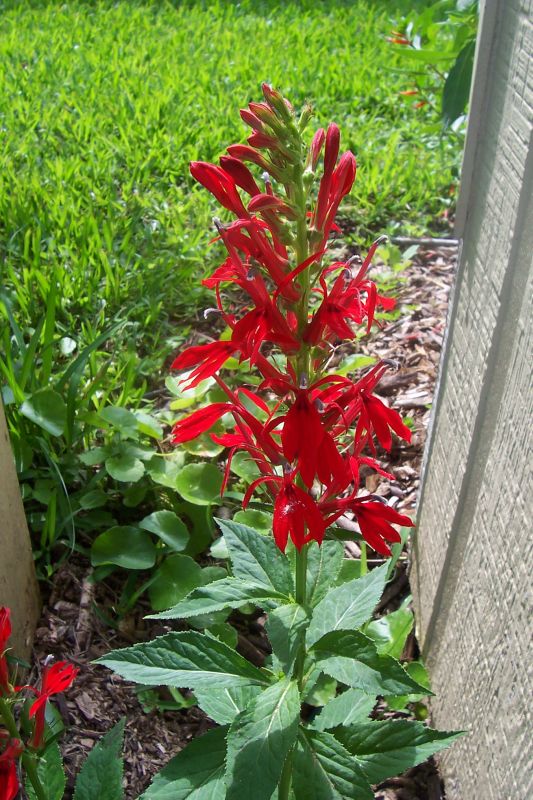
Do you like hummingbirds?  I do and it gives me great pleasure attracting them to my yard with flowers that they love.  You could not do better than to plant some cardinal flowers (lobelia cardinalis.)  This is one of the favorite foods of the ruby-throated hummingbird.  Not only that, but it is also one of the few flowers that blooms well in shade. 


Cardinal flowers are perennials that like a shady, moist spot.  They really grow well next to a shady pond.  In the late spring they send up tall spikes of the deepest red flowers you can imagine.  They slowly spread as they come back every year.  I haven't seen any pests on mine.  They are quite hardy and grow even as far north as Canada.  Let's all plant some and keep the hummers happy.


Wednesday, June 16, 2010

Singing the Praises of Plumbago


Time for my annual post to sing the praises of plumbago.  I've got all new pictures to go along with my redundant rant. 

First off, look at this perfect light blue color that goes with just about anything.  Makes for a wonderful companion plant.

It makes beautiful little clusters of bloom.  They are not fragrant, but they are profuse.  And guess what?  They continue from late spring all the way till frost!


The bush istelf has a very pleasing rounded, bushy form.  If it gets too floppy, just cut it back some.  It likes full sun and moderate water needs.  I don't know that it has major soil preferences.  In zones 8 and higher it comes back every year.  It is very easy to root from cuttings and it hasn't been an invasive spreader for me at all.  In fact, I wish it would spread more.  I have yet to see a single pest, whether insect or disease, that has affected this wonderful plant.  It's hard to imagine a better cottage garden plant for the Deep South.  About the only complaint that could be lodged against this plant is its lack of fragrance.  Go get you some!

Tuesday, June 15, 2010

Garden Bloggers' Bloom Day - June


Every month on the 15th, May Dreams Gardens hosts the Garden Bloggers' Bloom Day.  You are supposed to put pictures of what all is blooming in your yard on your blog and then link it to the MDG site.  So here is my contribution of the month. 

Joan Senior Daylily


Mrs. B. R. Cant rose


Prosperity rose


Becky Shasta daisies


Plumbago blooms


Cashmere Bouquet (clerondendrum bungei)


Magnus Purple Coneflower

Some of the other flowers in bloom in my yard at this time are gladiolas, gardenias, sunflowers, zinnias, honeysuckles, Victoria Blue salvias, Chaste vitex, achillea, lantanas, altheas, crape myrtles, coreopsis, gaillardia, hardy hibiscus, and cardinal flowers.  I just can't put pictures of them all in one blog entry!