Sunday, June 27, 2010

Hot Summer Blooms

As the days get hotter and the humidity turns Louisiana into a steam bath, I start looking for plants that perform in these horrid conditions.  Many flowers and plants either take a break for a couple of months, or else they languish or even die.  This is when you must turn to tropical plants or those that are native to really hot areas.  One such plant is the Mexican sunflower, or tithonia.  This hot-colored plant laughs at hot, humid conditions.  It stays lush, blooms like a fool, and invites all butterflies in the neighborhood to come over for a drink.  The blooms are so bright orange that they are hard to photograph.  This first picture is from last year.


This next picture is of my first bloom from this year.  These plants start blooming in mid to late June just when other flowers are playing out or quitting.  The butterflies and bumblebees flock to this flower.  It is a MUST HAVE if you want to attract butterflies!  I've seen nearly every type of butterfly that lives in my area nectar on these blooms - swallowtails of all types, monarchs, Gulf fritillaries, and many others. 


These plants re-seed prolifically if you let them.  They can be planted at nearly any time once the soil warms up.  They don't want any special care.  They get about 5 feet tall so a strong wind might make them flop over.  To combat this, I like to snip them back so as to make them shorter and stockier.  The definitely need nearly full sun to thrive.  They are a good companion plant to zinnias, cosmos, marigolds, salvias, coreopsis, and butterflyweed.  You might want to look for certain varieties that are supposedly shorter and less prone to flopping.  I'll end this with some pictures of butterflies nectaring on my tithonias last year.


Saturday, June 26, 2010

Daylily Collage

Today is a day for daylilies.  They have been blooming at peak for the last several weeks at my house.  I love how they are so florific.  I need to utilize them better as companion plants in my various flower beds.  This first picture is of one of my favorites - Joan Senior.  Such a nice color that mixes well with nearly any flower.  Joan S is a good daylily for full sun since it isn't affected by fading from the sun.  Also, this is one of my longest blooming daylilies.  It just keeps pumping out blooms.


This next picture is Joan Senior with Chicago Apache.  It's one of my favorite pictures of this year.  That velvety red of Chicago Apache stands out so well next to the creamy white of Joan Senior.  Chicago Apache looks best in partial shade and would definitely brighten up a part shade flower bed.


This next picture is of a pink daylily that was given to me.  I have no idea what it's name is, but I like it.  It would be a good candidate to go in a cottage garden.  The pink gets a little softer after the sun has shined on it some.


This last picture is of another unknown variety that I have.  It's a deep wine/burgundy color that looks best in the early morning before the sun has faded it some.  This one is another great candidate for a partial shade garden where the sun won't affect its color as much. 


I have a goal to utilize daylilies more in the coming year as companion plants to my other flowers.  This fall it will be time to divide them and I fully intend to spread them around more.  Right now, most are planted in a bed with other daylilies.

Wednesday, June 23, 2010

Victoria Blue Salvia

There are many types of salvias and they have an almost cultish following.  They come in so many variations and are so easy to care for that people just can't get enough of them.  They are also pretty deer resistant and many come back every year.  Those that don't come back are easy to grow from seed and some of them are ready re-seeders.  Add that this the fact that hummingbirds, butterflies, and bees love them and you have a recipe for a favorite flower. 


This blog entry is about my Victoria Blue salvia (Salvia farinacea).  This salvia is a perennial in my area of the country and makes these beautiful purple/blue spikes of flowers.  The plant is mounding and has a nice shape. 


I've got a clump of these planted in one of my butterfly beds.  They are growing in the midst of some pentas and tithonias.  I'm hoping they spread more and more and I can divide them to plant in other areas and share with friends.  There are many other types of salvias to grow besides these.  I have some salvia leucantha (Mexican bush sage) planted in another place in my yard and I have planted salvia coccinea in years past.  Nearly all do well throughout the US, as long as they get full or partial sun. 


Friday, June 18, 2010

"I've Got a Tiger By the Tail"

Certain plants just look more tropical than others.  One of those REALLY tropical looking plants is the canna.  Cannas are common all over the South and everyone has them.  They are almost too easy to grow and you commonly see huge stands of thickly growing, stunted ones that do not look good at all because they have been devastated by leaf roller caterpillars.  This is certainly not the look that I wanted.  However, there was one canna that really captured my interest and I had to have one - the Bengal Tiger canna.


This is my little Bengal Tiger canna as it first began to come out this year.  Can you guess why it got the name Bengal Tiger?  It's because of the striped leaves, of course.


Here's another picture as it came out even more.  Notice the yellow stripes on the leaves and you can also see the red outline on the outer edge of the leaves.


Here's a full bush shot of the plant as it is about to bloom.  These plants have a beautiful form when at their best.  They will keep looking good as long as they are kept from getting too thick and you keep canna leaf rollers off of them.  You may have to use pesticide to keep those evil insects away. 


Here's a close-up of the blooms.  Maybe some of the Bengal Tiger name also came from the bright orange coloration of the blooms.  By the way, this canna is also called Pretoria in some places.

If you want to grow cannas, plant them in almost any soil and give them plenty of water.  They do not perform well in dry conditions.  They are great to plant in a boggy area of your yard.  They need full sun to bloom best, but they perform remarkably well in part shade.  You can even grow them in nearly full shade, though they probably won't bloom.  Bengal Tiger looks great even when not blooming, so it would be a good candidate for a shady area.  They spread rapidly and should be divided at least every three years.  There will be plenty to give away to friends.  I have a strong preference for cannas with variegated foliage because they look good even when not in bloom.  They need to be dug up in the fall if you live in an area where the ground freezes.  There are many different flower colors to choose from as well as ones with red foliage.  There are even dwarf varieties that you can try.  If you are wanting to grow a tropicalesque garden, you must have cannas along with your bananas, palms, and hedychiums.  So give them a try and you might find yourself enjoying this old Victorian favorite.


Moss Rose Follow-Up


In light of my post the other day on portulacas, I wanted to post a picture that I took this morning.  This particular plant is putting on a show in a container that I sprinkled some seed in a few weeks ago.  My camera is not of good enough quality to really do these blooms justice since it can't seem to capture the actual color.  Anyway, I just wanted to share it with the blogging world.

Thursday, June 17, 2010

A Few of My Favorite Blooms


Occasionally I like to post some pictures of my favorite Abraham Darby rose blooms, just because I love them.  Right now the bush itself is a terrible blackspot mess, but it's still pumping out these luscious, fragrant blooms of apricot/pink.  This is why I can't get rid of this rose despite the lack of blackspot resistance.


This first picture is one of the buds before full bloom.


Now for a few different blooms at various angles.  Enjoy!


If you could only smell them too!  Feel free to click on the pictures to enlarge them and see better.  Notice the spider on the last picture.

Do the Hummingbirds a Favor


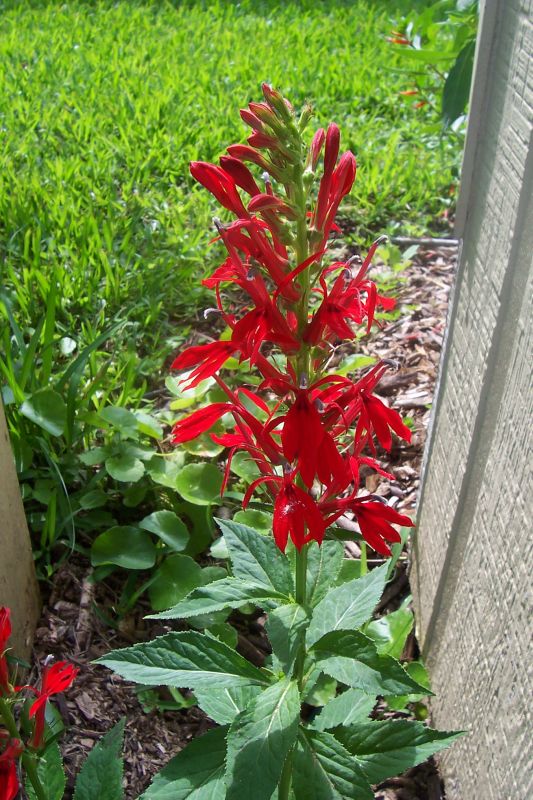
Do you like hummingbirds?  I do and it gives me great pleasure attracting them to my yard with flowers that they love.  You could not do better than to plant some cardinal flowers (lobelia cardinalis.)  This is one of the favorite foods of the ruby-throated hummingbird.  Not only that, but it is also one of the few flowers that blooms well in shade. 


Cardinal flowers are perennials that like a shady, moist spot.  They really grow well next to a shady pond.  In the late spring they send up tall spikes of the deepest red flowers you can imagine.  They slowly spread as they come back every year.  I haven't seen any pests on mine.  They are quite hardy and grow even as far north as Canada.  Let's all plant some and keep the hummers happy.


Wednesday, June 16, 2010

Singing the Praises of Plumbago


Time for my annual post to sing the praises of plumbago.  I've got all new pictures to go along with my redundant rant. 

First off, look at this perfect light blue color that goes with just about anything.  Makes for a wonderful companion plant.

It makes beautiful little clusters of bloom.  They are not fragrant, but they are profuse.  And guess what?  They continue from late spring all the way till frost!


The bush istelf has a very pleasing rounded, bushy form.  If it gets too floppy, just cut it back some.  It likes full sun and moderate water needs.  I don't know that it has major soil preferences.  In zones 8 and higher it comes back every year.  It is very easy to root from cuttings and it hasn't been an invasive spreader for me at all.  In fact, I wish it would spread more.  I have yet to see a single pest, whether insect or disease, that has affected this wonderful plant.  It's hard to imagine a better cottage garden plant for the Deep South.  About the only complaint that could be lodged against this plant is its lack of fragrance.  Go get you some!

Tuesday, June 15, 2010

Garden Bloggers' Bloom Day - June


Every month on the 15th, May Dreams Gardens hosts the Garden Bloggers' Bloom Day.  You are supposed to put pictures of what all is blooming in your yard on your blog and then link it to the MDG site.  So here is my contribution of the month. 

Joan Senior Daylily


Mrs. B. R. Cant rose


Prosperity rose


Becky Shasta daisies


Plumbago blooms


Cashmere Bouquet (clerondendrum bungei)


Magnus Purple Coneflower

Some of the other flowers in bloom in my yard at this time are gladiolas, gardenias, sunflowers, zinnias, honeysuckles, Victoria Blue salvias, Chaste vitex, achillea, lantanas, altheas, crape myrtles, coreopsis, gaillardia, hardy hibiscus, and cardinal flowers.  I just can't put pictures of them all in one blog entry!

Monday, June 14, 2010

The Moss Rose Gets No Respect

What would you say if I told you I have a nice annual flower that almost never needs to be watered, thrives in poor soil, readily reseeds in places where other stuff won't grow, and comes in every conceivable color?  You'd jump at the opporunity to get such a plant.  Oddly enough, we have it in the form of the portulaca, or moss rose.  You don't see people singing the praises of this lowly little annual enough.  It's easy to grow from seed, thrives in pots where it gets little care, blends nicely with other plants, and doesn't need any particular soil type.  This first one I'm showing is growing in the cracks of my concrete driveway and reseeds itself every year.


Next up is a pink portulaca - they come in all colors, as you will see in the following pictures.


This is a light yellow one that would be a great companion color to many types of flowers.


Next, my favorite color of the ones I have - bright orange.  Isn't this striking?  All my portulacas are of the Sundial variety, but I haven't met a variety that doesn't do well. 


Last, a deep yellow cultivar.  For those of you who want cheap and easy, moss rose is the flower for you.  Just moisten some dirt and throw the seeds on top.  You don't even need to cover them.  Water only sporadically, if at all.  These things thrive quite well on whatever rain happens to come.