Monday, April 11, 2011

This Rose is Cooking!


This delightful, butter yellow rose is named after the famous cook, Julia Child.  I'm guessing it's because of the butter yellow color. 


The bush stays somewhat small and rounded as most floribunda roses do.  The deep green of the leaves sets off the yellow blooms perfectly.


Many floribundas have no fragrance, but this one is an exception.  It has a unique licorice-like fragrance that is very interesting and pleasant. 


This variety does fairly well without spray, but in late summer it gets blackspot and looks ragged.  It would peform better with fungicidal spray. 


The floribunda roses are all ever-bloomers, meaning they will almost continually be in bloom from spring till frost.  The spring flush is the most spectacular.  In the heat of summer, the yellow can be lighter and less rich.  This is one of the most popular floribundas on the market right now because it's such a good performer. 

Sunday, April 10, 2011

The Chronicles of Crepuscule


Last year for my birthday, I got a gallon plant of the climbing noisette rose Crepuscule.  It is a lovely apricot rose that was first developed in 1904, so it is definitely an old rose.  My research led me to believe that this noisette would love the hot, humid weather of Louisiana since the noisette family of roses originated in Charleston, South Carolina.


After only one year of growth it has not disappointed!  In it's first full spring in my yard it is exploding with blossoms.  I don't know if you could fit another bloom on this little climber.


The blooms are semi-double in form and have a pleasant, noticeable, and sweet fragrance.  The leaves are a beautiful spring green and totally undiseased for me in the first year, even without any fungicide.


The plant is not very large yet, but I would definitely describe the growth in the first year as vigorous.  It is already developing long, easily trained canes to clamber along the fence with.  I also really enjoy how bushy the plant is from the ground up.  Most climbers have "naked legs" that take away from the beauty of the plant.  Another pleasant thing about this rose is that it is not very thorny at all.  If this plant is characteristic of how all the noisettes perform in the South, then GET YOU SOME! 

I will be posting lots of roses in the next few blog entries because they are at peak bloom right now for me.  Hope you enjoy.  Sorry that my camera doesn't do well with some colors.

Friday, April 1, 2011

One of the Best Smells in the World


Every year I put out at least one blog post on one of my favorite shrubs of all time.  It's the seldom praised Michelia figo, more commonly known as banana shrub or magnolia fuscata.  


In the spring (and some in the fall too) it forms hairy, bulbous buds that soon turn this creamy white and burst forth to release the most amazing and wondrous fragrance imaginable.  The fragrance is like Juicy Fruit gum, only better, and I have yet to ever meet a person who doesn't nearly swoon over it.


As you can see, the blooms aren't all that showy and don't really stand out.  You would never guess by looking that they put out such a heavenly fragrance.  My large shrub will fill nearly the whole yard with fragrance when the wind is not blowing.  It makes a walk in the yard pure delight.  You can take several blooms into your house and they will keep their odor and fill a room with it for several hours.


If the flowers aren't all that showy, the plant IS.  It makes a full, voluptuous shrub with shiny green leaves that are evergreen.  The plant can get over 12' tall down here in Louisiana and somewhat resembles a magnolia.  It appreciates part shade - the leaves will be more yellow in full sun.  Mine is thriving on the Northeast corner of my house next to this Formosa azalea.  It prefers loamy, slightly acid soil with plenty enough moisture.  This plant makes a wonderful part shade shrub to use as a background to more colorful plants.  It could also be used as a slow growing hedge.  It is unbelievable to me that this plant is not more widely known and grown.

Thursday, March 31, 2011

My Favorite Weed


Every spring, grass-like clumps of growth start showing up in my back yard.  My wife is carefully instructed not to mow these down as they will eventually lead to these cute little blue flowers that look so cottagey and nice.  These clumps are the wildflower tradescantia that is native to my area.  It is also known as spiderwort.


I have never planted them and do not give them any care beyond not mowing them until they cease blooming and start to yellow.  They thrive in the back yard and add cheer to my daily walks.  They will eventually form a clump about 2' x 2' in size.  There is no fragrance to speak of.  Towards the end of spring, we mow them down and they disappear until the following spring.  Their bloom time lasts for about a month in my yard and is usually around the same time as the irises and azaleas.  The blooms on mine are medium blue and they close up when the sun gets hot around mid-day.  They will do best in part shade with moist soil.  They might be a good plant for a cottage style garden.  As it is, I will just let mine keep growing where they please in my back yard.

Sunday, March 27, 2011

A Tidal Wave of Silver


This perfect bloom comes from my Tidal Wave Silver plant.  It looks so good that I wish I had planted more of them.  The blooms are lavender with a deep purple throat and the color really sticks out against the deep green of the foliage.


Not only that, but there are lots of these blooms covering the plant.  This plant was on a trial run for me this year, hence there being only one of them in the ground.  Next year there will be more of them! 


Down here, petunias should be planted in October or November and allowed to over-winter in the ground.  This particular cultivar is known to get larger and more "filling" than other types.  It should be a wonderful addition to a Southern cool season cottage garden.  If the bed this one is in looks over-run, it's because of all the clover and nigella growing in it.  I don't want to pull up the clover for fear of uprooting my beautiful, self-seeding nigellas ("love-in-a-mist.")  This will be one of my summer butterfly beds after the petunias and nigellas play out.  It will be filled with zinnias, salvias, and tithonias starting in May.

Friday, March 25, 2011

A Paradise of Azaleas

The azaleas are about to reach peak bloom in my area.  Some aren't there yet, but will be in a few days. 


This first bush is the oldest and most common azalea in these parts - the venerable Formosa azalea.  It gets huge and is still breath-taking at peak. 


This is a close-up of the Formosa blooms.  The hot pink color really stands out on the bush and in the yard.


These are some smaller bushes that I have around the North foundation of my house.  They are Red Ruffles and Pink Ruffles.  They don't get nearly as huge as the Formosas but are covered in bloom and look better as a foundation plant. 


Here is a better shot of the Pink Ruffles blooms


I would be negligent not to include at least one picture of the blooms on my new Encore Autumn Moonlight azalea.  These will bloom several times per year instead of only in the spring.  However, they are not as covered in bloom as the once-bloomers.  The Encores like more sun than regular azaleas.


Here is a picture of my best Red Ruffles plant.  It's not quite at full bloom yet, so I'll try to post some more pictures in a few days. 

Everyone in the South should grow at least a few azaleas.  Northerners would die to have them, so anyone who can grow them is downright remiss if they don't.  Plant them in part sun, mulch them well - preferably with pine straw - don't let them get too dry while young, and watch them grow.  They need acidic soil so it might be advisable to get yours tested.  You can put additives into the soil to make it more acidic. 

Wednesday, March 23, 2011

Let's Get a Little Sun

Arizona Sun, that is.


This is my Arizona Sun gaillardia, a mounding and spreading perennial that  faithfully has returned in my landscape for several years.  This plant famously takes heat and drought and will bloom from spring till frost.  Mine starts blooming in March and quits in December.  Could you ask more of a plant?


The blooms are an almost garish color and need to be deadheaded to keep up best production.  The sizzling color fits my mood best in the summer. 


The plant is low and mounding.  It can be divided every three years or so if you want more of them.  I actually planted these from seeds, but they didn't flower the first year.  It's easier to just buy some plants - if you can find them.  This plant is not a common sight at your local garden centers.  In the Southeast, I recommend you plant them in a hot, dry spot where you don't want to water or irrigate. 

Tuesday, March 22, 2011

Honest Abe


Abraham Darby is supposed to grow like a climber in Louisiana, but mine has never done this.  The canes get relatively long, but they are stiff and just not long enough to train along the fence.  So this year, I pruned mine way back somewhat like a hybrid tea.  I'm hoping the plant will fill out and get more thick and bushy than in past years because of this.  There is no blackspot yet, so Abe is looking good.  By June blackspot will have decimated this plant and it won't look so good. 


In spite of the blackspot problems, I cannot resist these luscious, full blooms.  This is the reason I keep this rose - not to mention the strong, fruity fragrance that I love so well.  The blooms are more pink now, but become apricot as hot weather comes in.  Not recommended for easy care.

Monday, March 21, 2011

A Visit With the Madame


Madame Alfred Carriere ("MAC") is a fine old white, climbing rose with a sweet fragrance that wafts on the breeze on a cool spring morning.  The buds start off a light, soft pink.


They stay this light pink as they open, but soon fade to a lovely, pure white.  This plant will be covered in blooms in a week or so.


It becomes quite a large climber in the South.  Mine is planted in the shadow of a big live oak tree and so is not in the ideal location.  Still, it's making the best of the situation and blooms beautifully.  There is a large flush in the spring, followed by sporadic blooms throughout the summer, and another smaller flush in the fall.  She loses about half her leaves to blackspot during the summer, but readily recovers and shrugs off the disease.  If you plant this rose on a pergola or arbor, you might also want to plant some bush rose at its base to hide the bare legs.   I recommend Marie Pavie as a nice complementary rose to go with this one.  Another thing to like about MAC is how few thorns she has. 

Sunday, March 20, 2011

A Forgotten Favorite


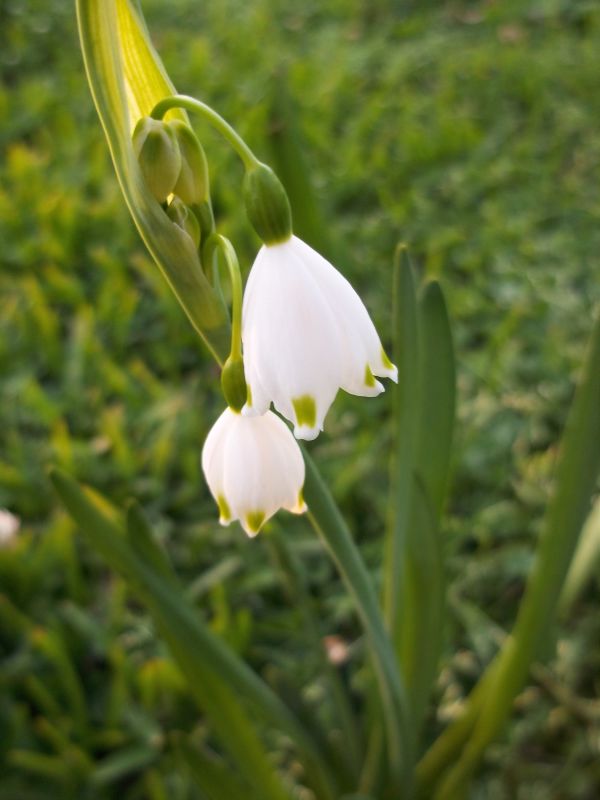
This is the venerable Summer Snowflake ("Gravetye Giant.")  It's Latin name is Leucojum aestivum, so use that term if you're looking for information on the internet to make sure you have the right plant.  This plant blooms at the same time of year as daffodils, has a slight fragrance, and forms large clumps over time that are very attractive.  I think they look nice as a bordering plant.  They also make a nice addition to a mixed bulb bed.  Once upon a time, these were quite popular, especially in the Deep South.  This was mostly because they thrive where many other bulbs won't grow.  For one thing, they don't need as much chill as daffodils, tulips, and many other spring bulbs.  For another, they take clay soil and boggy conditions like a champ.  To me, they resemble Lily of the Valley.  This neat old plant will naturalize well with basically no care at all.  Plant the bulbs 3" deep anywhere that it will get at least part sun.  They should be planted in Fall along with daffodils.  For some good information on this plant, I recommend you make a side trip to Floridata and check it out.  On a side note, this would be a perfect plant for a moon garden.